The Cap Table Mistakes That Kill Great Startups (Before the Pitch Deck Does)
If your cap table needs a 20-minute explanation, your round is already dying. Learn the three patterns that make investors pass.
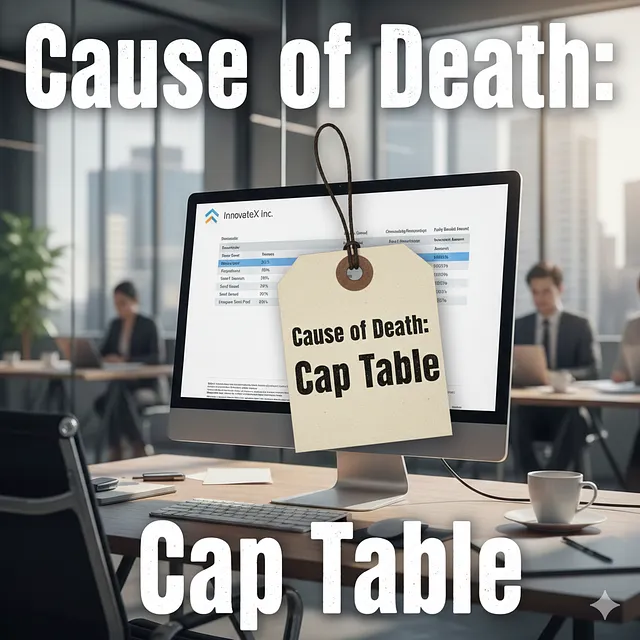
If your cap table needs a 20-minute explanation, your round is already dying.
As a venture capitalist in deep tech and the managing partner at MARL Accelerator, I've reviewed 5,000+ early-stage companies.
I've watched founders build real sci-fi — AI copilots, robotics, space hardware, next-gen networks.
And I've watched rounds die quietly… over a spreadsheet.
Not because the product was weak. Because the cap table was.
Here's the uncomfortable truth: the cap table is the fastest trust test in venture. If it's confusing, investors don't "lean in." They step back. Quietly.
The stat that should scare you
Carta's Founder Ownership Report shows that after a priced seed round, the median founding team still owns 56.2% of the company. (Source)
That's the "healthy" path — when early ownership decisions are intentional.
But if you show up already messy, you don't just lose points. You lose time.
And time kills rounds.
Three patterns we see (and why we pass)
1) Logistics AI: the $100 SAFE advisors
We opened the cap table and saw four advisors listed as SAFE holders at a $100 cap.
Yes. One hundred dollars.
At that moment, the product became irrelevant — because the cap table told us the next six weeks would be legal cleanup, renegotiation, and awkward calls with people who think they "own" the company.
This is not "aggressive terms." This is "nobody knows what's true."
We passed.
2) ConstructionTech: the owner wasn't even in the room
Another company looked solid until we saw the major stakeholder: a subsidiary entity in India.
The founders had almost no shares.
It didn't make sense at first. Then it made too much sense: the structure was built for convenience, not for governance. Control was unclear. Incentives were broken. Future investors would have to underwrite cross-border complexity before underwriting the product.
We passed.
3) SpaceTech: the deal that hurt
SpaceTech. Amazing product. One of the most passionate founders I've met.
We wanted to invest.
Then we saw a co-founder on the cap table who hadn't been involved in a long time — no clean vesting story, no unwind path, no agreement everyone could live with.
Technically fixable. Practically lethal.
Because fixing it during diligence slows the round, spooks the lead, and forces the founder into emotional negotiations at the worst possible moment.
We passed. And I still regret that one.
Why investors react so strongly
Founders think cap tables are records. Investors treat them as predictions.
A messy cap table predicts:
- delayed closes ("we're still cleaning it up")
- renegotiations ("he wants more" / "she won't sign")
- governance fights ("who controls the board?")
- future round friction ("we can't price until it's clean")
You don't need a scandal to get rejected. You just need uncertainty.
The advisor equity trap
One of the fastest ways to poison a cap table is "advisor equity by vibes."
Carta's guidance puts the median pre-seed advisor equity at 0.25%, with a typical range of 0.1%–1% depending on involvement. (Source)
When I see multi-percent advisor allocations at pre-seed — especially with no vesting — I don't see generosity.
I see an upcoming cap table hostage situation.
Rule: if you need to explain it, you already lost
If your cap table requires a 20-minute walkthrough, you don't have a cap table.
You have a fundraising liability.
Most investors won't debate you. They'll just move on and say, "Not a fit."
How to fix this before it costs you a round
Do this before you send your first investor email:
- Standardize your instruments (stop stacking five different SAFEs)
- Put every advisor grant on vesting, with a real role and end date
- Remove ghosts (inactive co-founders) or document the unwind clearly
- Create a one-page "ownership narrative" (today vs post-round)
- Stop relying on a stale spreadsheet — broken cap tables are common when the "truth" lives in signed docs but the "model" is stuck in Excel
Final thoughts
The market can forgive a prototype. Investors can forgive early traction. But they won't forgive a cap table that signals chaos.
Fix it early. Help yourself.
And don't start from scratch. Download Carta's free cap table template and use it as the default structure your company follows (Summary + Stakeholders + Equity ledger + Option grants + Convertibles).
Originally published on Medium.